
Residential
- Home
- Residential
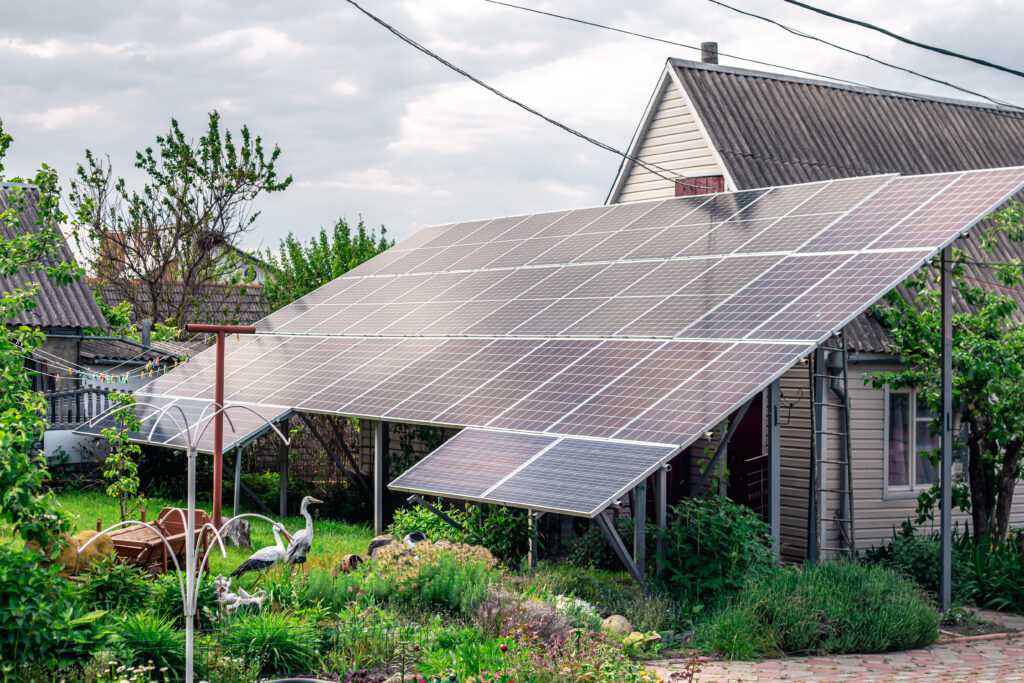
Residential Solar Rooftop Systems
Rooftop Solar Systems also known as Rooftop Solar Power Plants, which is an alternative form of Renewable Energy, is now readily being accepted and adopted for generating electricity by urban and rural population
Solar Energy is by far the most abundant Renewable Energy Source which is the reason behind it gaining popularity in cities and villages alike. Millions of homes and residential complexes are now installing Rooftop Solar Panels which are ideal for harnessing the abundant solar energy for power generation. Read below to know more about how to install Rooftop Solar panels for Home or Residential Use.
Installation requirements
To install Rooftop Solar System, the following criteria need to be met
- Roof dimensions and structure must support solar panel installation.
- Panels should ideally be south-facing for maximum sunlight exposure.
- A minimum of 100 sq. ft. rooftop area is needed for 1KW solar power output.
- Only MNRE/TSSPDCL/DISCOM-approved equipment should be used for subsidies and grid connectivity.
- The consumer must have a 1-phase or 3-phase electricity connection.
- A Bi-Directional Net Meter must be installed to measure power import and export.
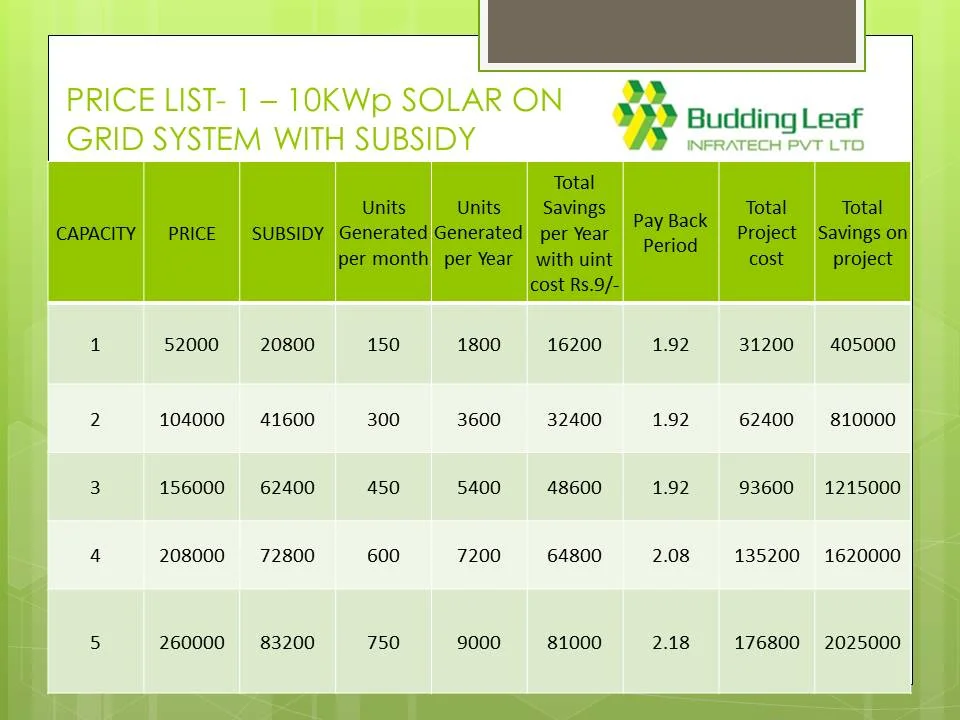
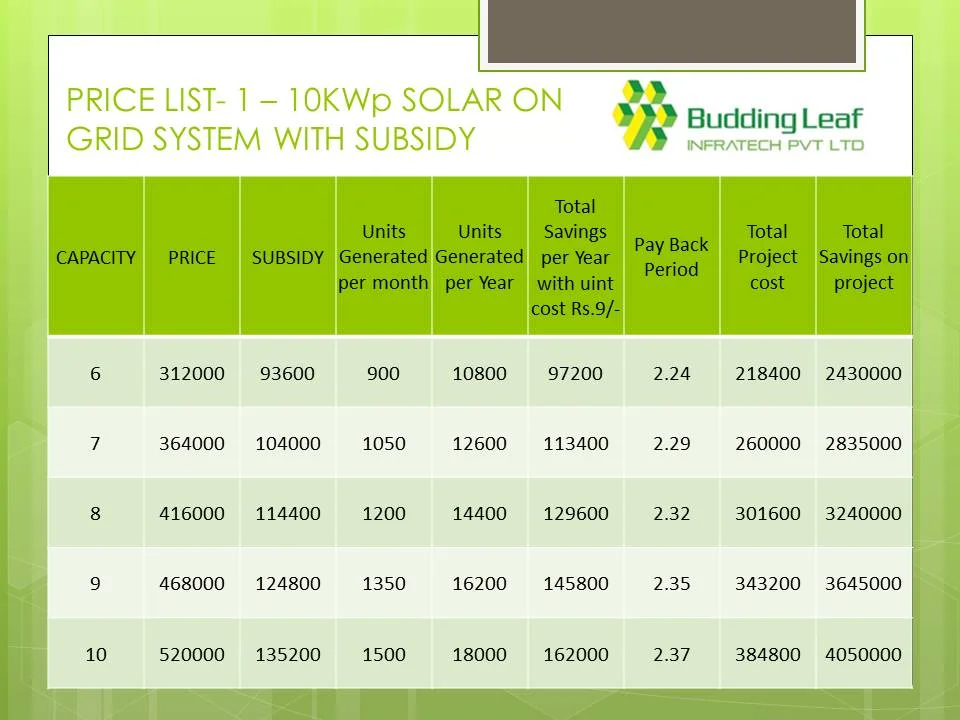
Cost of Rooftop Solar on Grid System from 1-10 KWp with Subsidy
REQUEST A CALL BACK
Get In Touch
Reach out to us for expert guidance, quick support, and reliable solar energy solutions.
-
+91 818 504 6666+91 818 504 6666
-
info@buddingleafinfra.cominfo@buddingleafinfra.com
-
Budding Leaf Infratech Private Limited H. NO: 7-1-32/A/17, C/O. MARUTHI KRUPA, LEELA NAGAR, AMEERPET, HYDERABAD. 500016Budding Leaf Infratech Private Limited H. NO: 7-1-32/A/17, C/O. MARUTHI KRUPA, LEELA NAGAR, AMEERPET, HYDERABAD. 500016
Download
How it Works
ON-GRID / GRID-TIED / NET-METERING SYSTEMS
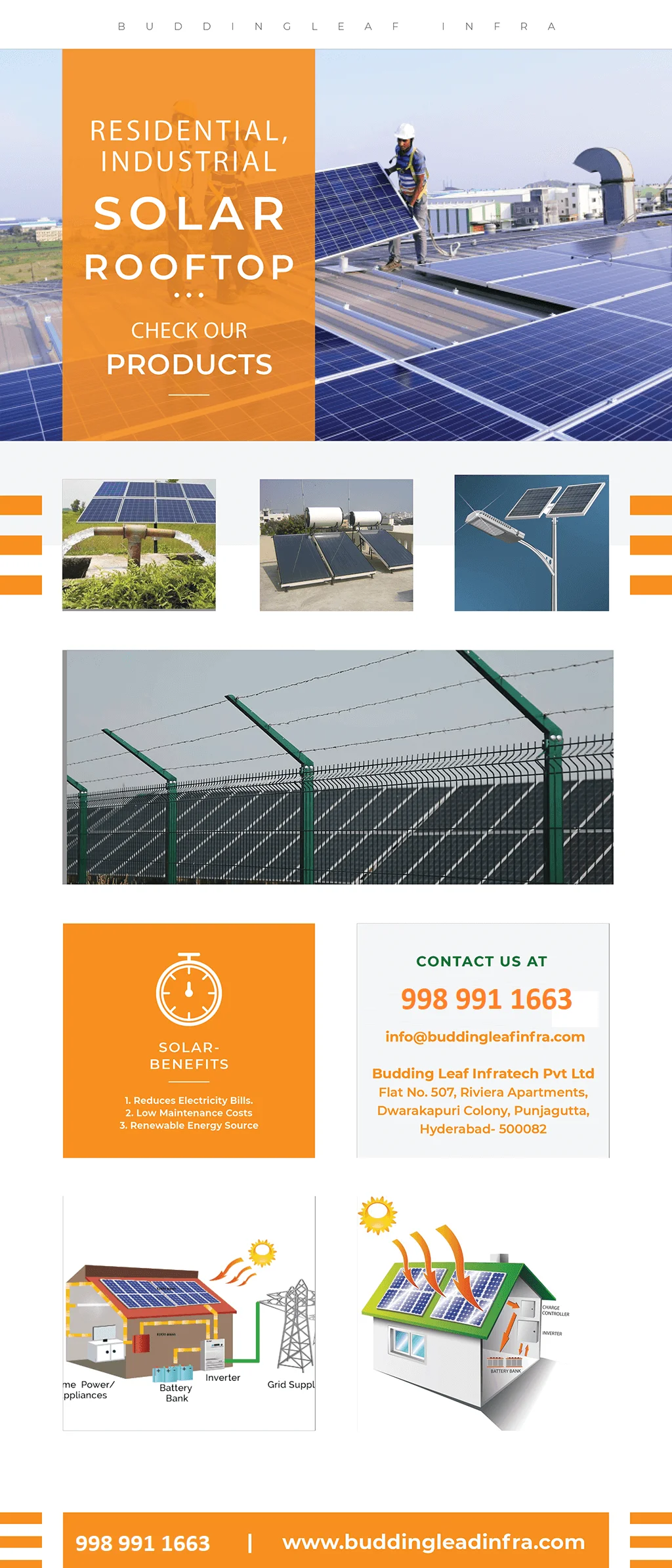
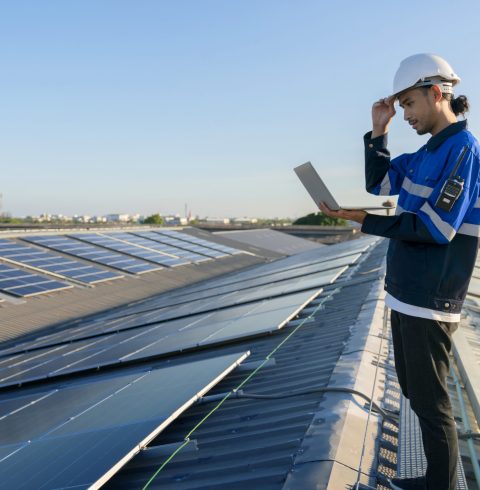
Solar panels operate on the principle of converting sunlight into usable electrical energy through advanced photovoltaic (PV) technology. These systems efficiently harness the sun’s abundant energy to power homes and commercial establishments, promoting clean and sustainable electricity generation.
Process Overview
- Sunlight Absorption: Solar panels, composed of numerous photovoltaic (PV) cells, capture sunlight as their primary energy source.
- Energy Conversion: Sunlight triggers reactions in PV cells, releasing electrons that generate direct current (DC) electricity.
- Power Transformation: Inverters convert the produced direct current (DC) into alternating current (AC) for household use.
- Energy Measurement: Bi-directional meters track grid energy usage and surplus solar energy generated simultaneously.
- Grid Export: Excess electricity produced by solar panels is exported to the grid for credit benefits.
Types of Solar Power System
ON-GRID/GRID-TIED/NET-METERING
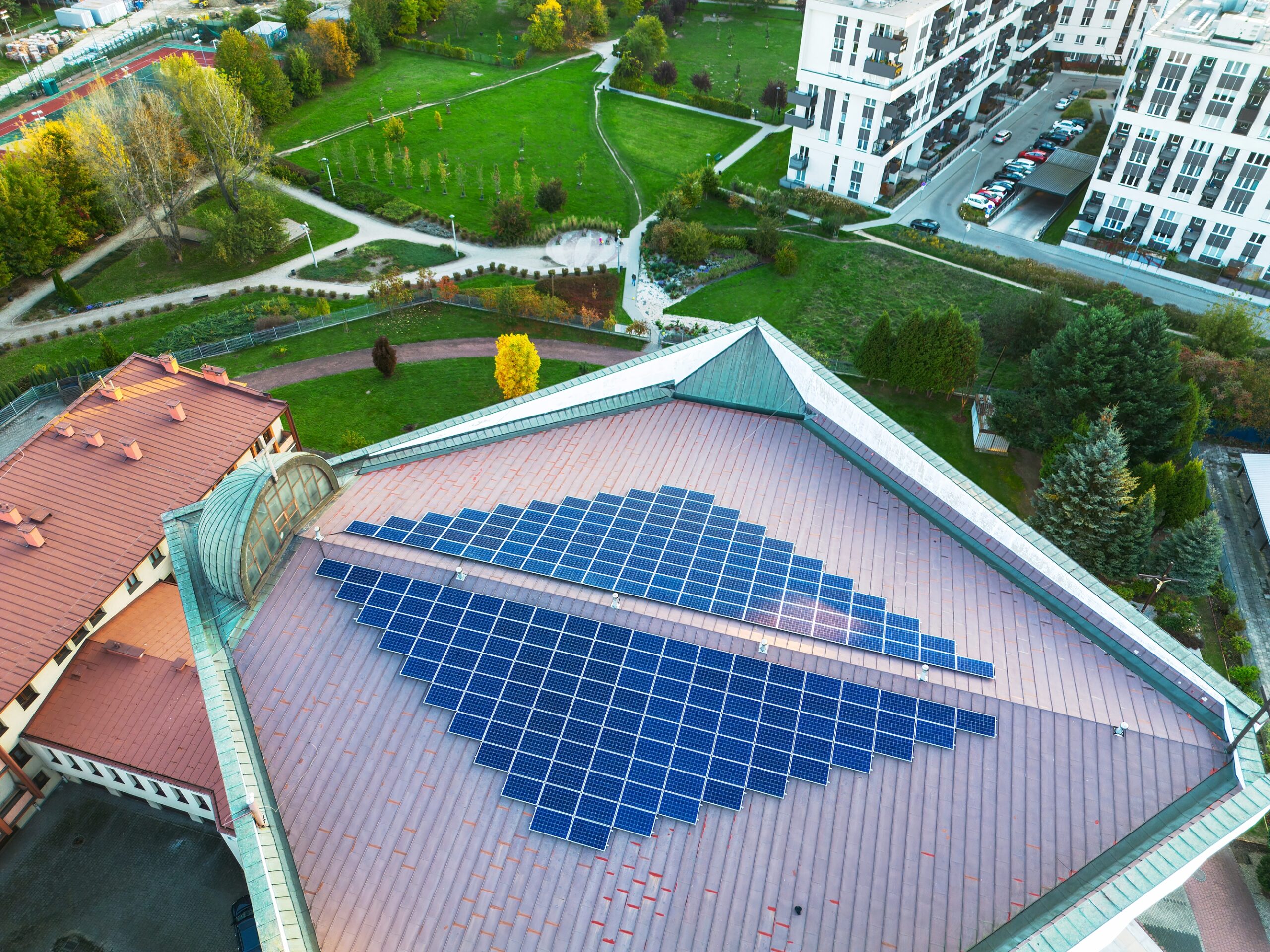
On-Grid Rooftop Solar Systems are efficient solutions that connect directly to the main power grid, enabling you to use solar energy during the day and draw power from the grid when sunlight is unavailable. These systems operate on Net Metering technology, where a Bi-Directional Meter measures power consumed, exported, and imported. Any excess electricity generated is fed back to the grid, earning you credits or compensation from the electricity board. By utilizing solar power effectively, On-Grid Systems significantly reduce monthly electricity bills, ensure uninterrupted supply, and even generate additional income through surplus energy export.
Types of Solar Power System
OFF-GRID/GRID-TIED/NET-METERING
Off-Grid Rooftop Solar Systems are self-sustaining energy solutions that operate independently of the main power grid. These systems store electricity generated by solar panels in high-capacity batteries for later use, ensuring reliable power during outages or in remote areas. By providing uninterrupted energy and reducing dependency on traditional grid supply, they offer a sustainable, efficient, and cost-effective alternative for consistent power availability.
Advantages of Solar Rooftop
- Idle rooftop space utilization
- Cheaper Electricity
- Reduced power bills
- Clean, green energy generation
- Free from power cut problems
- Additional revenue give me in points
Solar Rooftop Projects We Delivered

Hyderabad

Bandalguda

Madhura Nagar

kukatpally
Our Achievement
ON-GRID/GRID-TIED/NET-METERING
Our Achievement
Our achievements reflect years of dedication, innovation, and excellence in solar and wind energy solutions, delivering sustainable projects and building long-term client trust nationwide
- Solar Power Systems
Why Budding Leaf for Solar Power Systems?
- FAQ’s
Frequently Asked Questions
Solar rooftop systems can be installed on the terraces or roofs of housing societies, residential complexes, commercial and industrial establishments, community centers, educational institutions and government organizations.
The efficiency of the solar rooftop system essentially depends on the shade-free area for the panel installation. It is essential to set up solar panels at the places receiving sunlight throughout the day. As a rule of thumb, you would need about 10 square meter or 100 square feet of shade-free area for installation of 1KW capacity solar system.
Solar rooftop systems generally come with at least 20 years of warrant but can easily last for up to 25 years and can even work longer, if maintained properly. The solar PV systems are subject to minimal physical damage as they don’t have moving parts. However, they are prone to wear and tear and typically known to degrade by about 1% each year.
Including the installation charges, a grid-connected rooftop solar system can range between Rs. 45,000-50,000 per kWp (kilowatt peak), while off-grid solar rooftop system costs around Rs one lakh per kWp.
Solar-powered rooftops do not require direct sunlight for their functioning as the electricity generated is stored in a battery to be used as required. For grid-connected solar rooftops, the system works even during the overcast weather. The efficiency, however, gets reduced to about 70%.
A subsidy is provided via state renewable departments and MNRE. Going by the current MNRE guidelines, Central Financial Assistance (CFA) subsidy is provided for the grid-tied solar systems. There is a provision of CFA of upto 30% of the benchmark cost for general category states and CFA of 70% of benchmark cost for states including Sikkim, Uttarakhand, Himachal Pradesh, Jammu & Kashmir, Lakshadweep, and NE states.
Residential Solar Rooftop Systems
Rooftop Solar Systems also known as Rooftop Solar Power Plants, which is an alternative form of Renewable Energy, is now readily being accepted and adopted for generating electricity by urban and rural population
Solar Energy is by far the most abundant Renewable Energy Source which is the reason behind it gaining popularity in cities and villages alike. Millions of homes and residential complexes are now installing Rooftop Solar Panels which are ideal for harnessing the abundant solar energy for power generation. Read below to know more about how to install Rooftop Solar panels for Home or Residential Use.
Installation requirements
To install Rooftop Solar System, the following criteria need to be met:
- The dimensions and the structure of the roof are crucial for feasibility of Rooftop Solar Power Panels. The ideal scenario if solar panels should be installed facing the south.
- A minimum of 100 square feet area is required at the roof for installation of solar panels producing power up to 1KW.
- The standard equipment as per the norms of MNRE/TSSPDCL/DISCOM shall only be installed to avail subsidies or grid-connectivity.
- The consumer shall have 1 phase/ 3 phase supply service connection.
- A single Bi-Directional Net-Meter shall be installed for export and import of power
Cost of Rooftop Solar on Grid System from 1-10 KWp with Subsidy
How it Works
How it Works
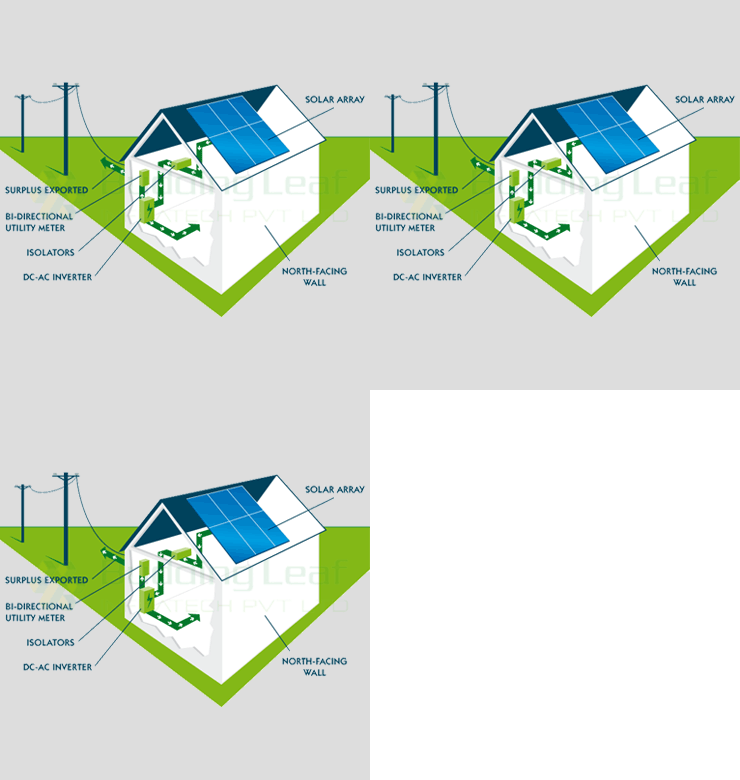
- The mechanism of working of the solar panels is that it absorbs the sunlight as a source of energy and then converts it into electricity.
- The solar panels are composed of many solar cells – which are photovoltaic (PV). This is the reason why solar power panels are also referred as solar PV panels
- It is these panels that absorb sunlight
- Once solar energy is completely absorbed, a chemical reaction is triggered within the solar cells which release electrons coverts solar energy into direct electric current (DC)
- An inverter then converts Direct Current produced by the solar panels to Alternating Current (AC) used in homes/residential buildings, as majority of household devices run on Alternative Current
- A bi-directional meter measures energy used and excess energy produced
- Excess electricity is fed to the grid
Types of Solar Power System

Advantages of Solar Rooftop
- Idle rooftop space utilization
- Cheaper Electricity
- Reduced power bills
- Clean, green energy generation
- Free from power cut problems
- Additional revenue
ON-GRID/GRID-TIED/NET-METERING
On-Grid Rooftop Solar Systems can actually reduce your monthly electricity bill! Since on-grid systems are incorporated with main grid supply, the power generated using solar energy during the day can be used and consumed by powering appliances and devices in homes as per the need. The excess solar electricity produced can be fed back to the grid. During night hours or cloud cover, the power can be drawn from the grid.
The grid-tied solar systems work on Net-Metering technology. In such systems, a Bi-Directional electricity Net-Meter installed in your homes or residential complexes records the power used, excess power exported to the grid and power imported from the grid.
If the electricity import from the grid, besides your power consumption from the solar electricity is more, you pay to the electricity board. But if the export of your solar power to the grid exceeds at the month-end, the board pays you the compensation.
The On-Grid Rooftop Solar Systems allow use of grid supply when Solar Power is not able to generate required electricity – during night or cloud cover. Otherwise, you can easily consume power without using grid supply and thus cut down on your electricity expenses.
Interestingly, this system can not only help you reduce your electricity bill but can help you earn money.

OFF-GRID
Rooftop Solar Panels can either be grid-connected or off-grid. The ‘off-grid’ Rooftop Solar Systems are not linked to the main grid but with battery storage. The electricity generated by the solar panels is stored in the battery system attached to the panels. This stored electricity can then be used to operate household devices and appliances.
The off-grid Solar Systems run by their own battery making it extremely reliable source of power. The main advantage of such a system can be advocated by the fact that it makes you independent of power cuts. Off-grid system comes to the fore during load shedding or when living in remote areas where power cut is quite frequent.
REQUEST A CALL BACK
QUICK LINKS

Need a Roofing Service?
-
+91 818 504 6666+91 818 504 6666
-
info@buddingleafinfra.cominfo@buddingleafinfra.com
-
AddressAddress #507, Riviera Apartments, Dwarakapuri Colony Punjagutta, Hyderabad - 500082, Telangana, INDIA
Download
our achivements
Why Budding Leaf for Solar Power Systems?
ON-GRID/GRID-TIED/NET-METERING
Rooftop Solar Projects Completed
Customer Support
Locations in PAN INDIA
Years in Solar Industry
Power Installations
Satisfied Customers
Solar Rooftop Projects We Delivered
Hyderabad
Bandalguda
Madhura Nagar
kukatpally
Our Testimonials
Driven by innovation and sustainability, they provide reliable, efficient and effective solar energy solutions which are technically viable for long term.
I had got a solar rooftop installed from Budding Leaf in 2016. It has been working well since then. Good maintenance and service from budding leaf.
Powered by innovation and excellence, Trusted name in solar energy. Great team and dedicated staff. Strength of Budding Leaf lies in its experience.
Committed to sustainability and customer satisfaction, great service and excellent product quality. Even their customer support is exceptionally outstanding.
Your guys were knowledgeable, experienced and efficient. Would highly recommend Budding Leaf to everyone for all kinds of solar energy solutions.
FAQ’s
Frequently Asked Questions
Solar rooftop systems can be installed on the terraces or roofs of housing societies, residential complexes, commercial and industrial establishments, community centers, educational institutions and government organizations.
The efficiency of the solar rooftop system essentially depends on the shade-free area for the panel installation. It is essential to set up solar panels at the places receiving sunlight throughout the day. As a rule of thumb, you would need about 10 square meter or 100 square feet of shade-free area for installation of 1KW capacity solar system.
Solar rooftop systems generally come with at least 20 years of warrant but can easily last for up to 25 years and can even work longer, if maintained properly. The solar PV systems are subject to minimal physical damage as they don’t have moving parts. However, they are prone to wear and tear and typically known to degrade by about 1% each year.
Including the installation charges, a grid-connected rooftop solar system can range between Rs. 45,000-50,000 per kWp (kilowatt peak), while off-grid solar rooftop system costs around Rs one lakh per kWp.
Solar-powered rooftops do not require direct sunlight for their functioning as the electricity generated is stored in a battery to be used as required. For grid-connected solar rooftops, the system works even during the overcast weather. The efficiency, however, gets reduced to about 70%.
A subsidy is provided via state renewable departments and MNRE. Going by the current MNRE guidelines, Central Financial Assistance (CFA) subsidy is provided for the grid-tied solar systems. There is a provision of CFA of upto 30% of the benchmark cost for general category states and CFA of 70% of benchmark cost for states including Sikkim, Uttarakhand, Himachal Pradesh, Jammu & Kashmir, Lakshadweep, and NE states.